Environmental Standard for Outdoor Apparel and Textile Products
A seal that makes it clear what it stands for.
With Green Shape®, you know exactly where you stand: verifiable environmental requirements throughout the entire product life cycle. Regulated transparently, documented in a traceable manner, and independently audited.
Before we get into the details: Green Shape®-certified products meet the following criteria, among others:
✅ Designed with the future in mind: Focus on material efficiency, repairability, and recyclability.
✅ Resource use at a glance: Consists of more than 50% recycled or renewable materials (based on textile raw materials).
✅ Verified supply chain: Meets strictly defined environmental requirements during manufacturing.
10 Phases – An Environmental Standard
Green Shape® evaluates not just a single aspect, but ten phases throughout the entire product life cycle—from supply chain planning to proper labeling, each with its own requirements and proof of compliance.
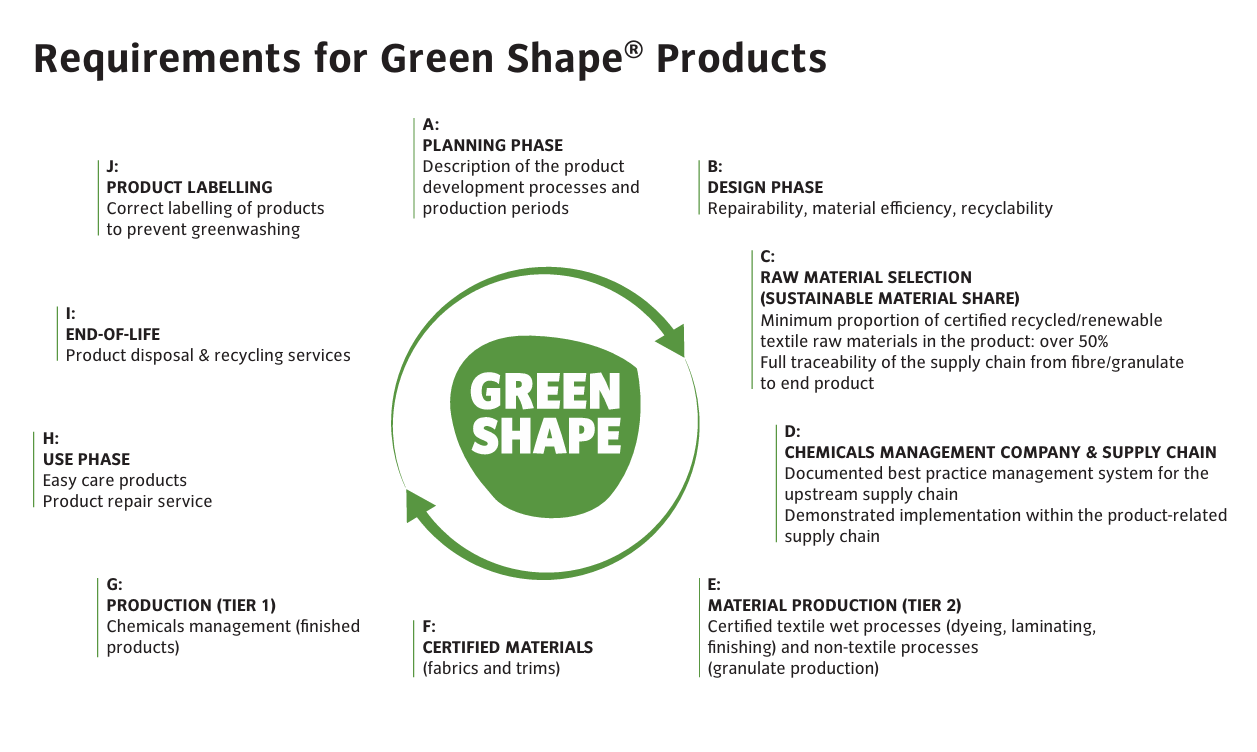
Requirements for Green Shape Products
Description of product development processes and production timeframes.
With every Green Shape product, every company knows exactly where each individual raw material comes from and the steps it has gone through to become the finished product—with a complete, unbroken chain of traceability from the very first fiber to the label. This makes it possible to demonstrate beyond a doubt for every single product that the certified materials and processes were indeed used.
Repairability, material efficiency, recyclability.
A product’s environmental friendliness is determined as early as the design phase. That’s why a standardized testing system evaluates how easy each product is to repair—for example, whether replacement parts are available and whether you need a repair shop or can fix it yourself. Material efficiency is also a priority in the design process: A material efficiency of at least 80% means that 80% of the raw material or fabric used actually ends up in the product. And when a material cannot be recycled, the company must demonstrate that it has made a serious effort to find a recyclable alternative.
The product contains at least 50% certified recycled or renewable textile raw materials. Full traceability of the supply chain from fiber/granules to the final product.
More than half of the textile weight of every Green Shape product consists of recycled or renewable raw materials—this is so important because the majority of a textile product’s environmental impact occurs during the extraction of new raw materials. Depending on the material, there is independent certification for this: organic cotton, for example, is certified by GOTS; wood fibers such as Lyocell are certified by the FSC label; and recycled materials are certified by the Recycled Claim Standard.
The company's documented management system for the upstream supply chain. Proven implementation in the product-related supply chain.
Many different chemicals are used in the production of textiles. Green Shape companies therefore contractually require their suppliers to refrain from using certain critical substances in the first place—both during production and in the finished product. This is set forth in two recognized lists compiled by independent professional organizations, known as the MRSL and RSL for short: binding guidelines specifying what may and may not be used in production. To ensure this isn’t just a matter of paperwork, the company must also demonstrate that it has its own chemical management system in place, and during the certification process, random checks are conducted to verify that tests for harmful substances in materials and wastewater tests are actually being carried out at the production facilities.
A defined minimum percentage of the materials used is manufactured in factories that have demonstrated compliance with a recognized environmental management system—for example, as a bluesign® system partner or in accordance with GOTS. This is important because dyeing, laminating, and finishing are among the most environmentally intensive steps in textile production. The assessment focuses not only on whether a company maintains good standards overall, but specifically on the individual factory where the materials for this particular product are manufactured.
Tier 2: Certified Materials (Fabrics and Ingredients).
The individual fabrics and ingredients themselves are also independently certified. Depending on the type of product, a minimum percentage—usually between 60 and 90 percent—of the materials and ingredients in the finished product is required. For certain sensitive material combinations, such as wax-coated fabrics, a separate test for harmful substances in accordance with Oeko-Tex 100 is also required.
Chemical Management (Finished Products).
The factory where the finished garment is sewn together is also contractually bound to adhere to the same chemical requirements as the previous production stages—and this applies to the entire final product, including all components it purchases separately. If this factory also performs its own dyeing or laminating processes, the same strict requirements apply to those as well. This ensures there are no gaps between the individual production stages—chemical management applies consistently all the way through to the final production step.
Low-maintenance products. The company's services and offerings for product repairs.
Green-Shape products are easy to care for: they’re washable at a maximum of 30 degrees, with no need for dry cleaning or a dryer. This reduces the environmental impact, since a large portion of a garment’s environmental footprint is generated during use—specifically through washing and drying. In addition, the company must actively support repairs—for example, by offering its own repair service, instructions, replacement parts, or clear information for customers. After all, the longer you can wear a product, the fewer resources are consumed overall.
The company's services and offerings for waste disposal and recycling.
If at some point you no longer use a product, the company won’t leave you to fend for yourself: It is committed to actively supporting recycling and proper disposal—for example, through drop-off locations, clear disposal instructions, or clear information on how and where you can return the product. The program verifies that these options actually exist and are widely publicized. While there is not yet a comprehensive, unified take-back system across the industry—Green Shape ensures that every certified company at least provides specific information on this topic.
Proper labeling of products to prevent greenwashing.
Green-Shape products honestly tell you what’s inside: the exact material specifications, including the percentage of recycled or organically grown fibers. You’ll find this information at a minimum in the sales materials, and often directly on the product itself. For products covered by the EU Textile Labelling Regulation, the legal requirements apply; all other product categories are labelled with the same level of care. This way, when you make a purchase, you know exactly what you’re getting—without vague or exaggerated environmental claims.
Testing & Verification
Trust is not built on a promise, but through a transparent process.
INDEPENDENCE
Green Shape e.V.
Since 2025, an independent, nonprofit organization has been the administrator of the standard and has further developed it into a fully-fledged certification system.
TESTING FACILITY
Independent Certification Bodies
Certifications are conducted by independent bodies that are accredited under ISO/IEC 17065 and approved for the Green Shape standard.
INSPECTION INTERVAL
Annual Monitoring
A certificate is valid for three years. Annual audits ensure ongoing compliance.
TRADEMARK STATUS
EU Quality Mark
The Green Shape label is registered as an EU certification mark—with clear award criteria that are publicly available in the brand manual.
Frequently Asked Questions
Green Shape deliberately focuses on environmental criteria—that is our core focus, and we delve deeply into this area. Working conditions at production facilities are also very important: All certified companies must comply with basic human rights due diligence requirements. GS e.V. verifies this prior to each certification.
Hundreds of chemicals are used in the production of textiles—some of them harmless, others not. Green Shape products therefore undergo a rigorous testing process: Suppliers commit to not using certain critical substances in the first place. In addition, both the materials and the finished product are randomly tested for residues. This is outlined in two lists compiled by independent expert organizations (RSL and MRSL)—put simply: binding guidelines for what may be used in production. We do not make a blanket statement such as “free of harmful substances,” as residues from other production processes may occur during manufacturing. What we can promise is this: We know which substances are critical, exclude them as much as possible, and monitor this closely.
Yes. It’s not enough for us to simply know which chemicals are permitted—we also want to know what actually ends up being released from the factory into the environment. That’s why manufacturing facilities are required to have their wastewater tested regularly, and during the certification process, we conduct random checks to verify that this is actually happening. This is how we ensure that the good standards set on paper are actually implemented in the factory.
Other certifications, such as GOTS, typically focus on a specific aspect—for example, whether the cotton was processed according to organic standards. Green Shape examines the entire product: from the selection of materials through manufacturing to whether it can be repaired or recycled later on. If a material already bears a recognized certification like GOTS, we consider that proof—so the certifications complement each other rather than contradicting one another.