Certification program and requirements for products
Transparent processes, structured documents, independent review
The Path to Green Shape® Certification
Certification under the Green Shape® Standard is carried out through a clearly defined, multi-step process. The goal is to provide a thorough evaluation and recognition of environmentally friendly products and product development processes.
The process at a glance:
- Application to Green Shape e.V.
Companies submit an application including a self-assessment. - Application review & License agreement
After a positive decision, a license agreement is concluded. - Select certification body & apply for audit
The certification body is freely chosen - it must comply with ISO/IEC 17065 and for the Green Shape Standard approved for the Green Shape Standard. - Audit and evaluation
The product development processes and product selection are by the certification body for conformity with the test program. - Certification decision
If the examination is successful, a certificate valid for three years is issued. - Monitoring & recertification
Annual audits ensure ongoing compliance with the requirements. Recertification takes place after expiry-audit.
All steps are carried out in accordance with the specifications of the Green Shape GS3.1 certification program.
Requirements for products and processes
Making sustainability measurable - with clear criteria for product and development
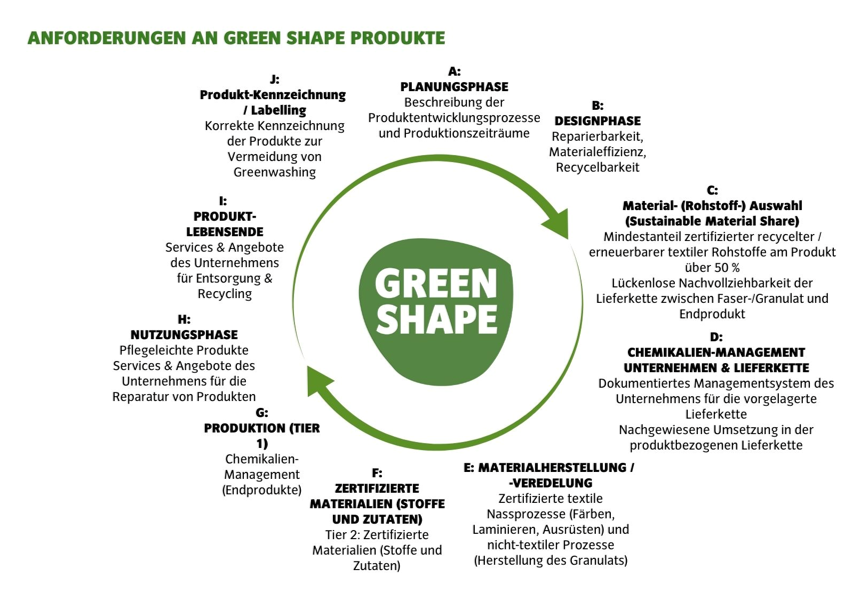
The Green Shape® standard is based on a comprehensive testing program that sets requirements for products and their development processes. It is grounded in a holistic approach that encompasses all phases of the product life cycle—from design to recycling.
What is checked?
The requirements cover the following areas:
- Product designAre ease of repair, recyclability and low-maintenance use already taken into account in the design process?
- MaterialsAre certified recycled or renewable materials used? Are environmental and chemical standards complied with?
- ProductionAre there environmentally sound processes along the supply chain? Are existing standards in manufacturing (Tier 1) and in material production (tier 2) recognized?
- Material efficiencyIs the consumption of materials planned and implemented in a way that conserves resources?
All these aspects influence how environmentally friendly a product actually is - and how credible an environmental claim can be.
Holistic life cycle approach
Green Shape® not only tests the finished product, but also takes into account the various factors throughout the entire product development process. This includes, among other things:
- Selection and proportion of sustainable materials
- Processing, finishing and chemical-related requirements
- Manufactured by certified companies with recognized standards (e.g. bluesign®, GOTS)
- Services & offers from the company for the repair and regulated disposal of the product
- Constructive design for long service life and recyclability
In the audit, proof is provided for each product that the test criteria are fulfilled in the relevant life cycle phases. This evidence is set out in the audit program and must be actively submitted.
What counts - and what doesn't?
Non-textile components such as zippers or press studs are not taken into account when calculating recycled or renewable material content: The focus is on textile product components.
When calculating certified minimum percentages, main and lining materials as well as ingredients (including non-textile) are taken into account.
Consistent environmental management in material selection, supply chains, and procurement
The Green Shape® Standard recognizes consistent management of chemicals, the supply chain, and procurement, which ensures high environmental standards within the certified company through credible commitments, documented procedures, and clear lines of responsibility. Best-practice companies also utilize high-quality third-party certifications for their upstream supply chain.
Proof & responsibility
Compliance with the requirements is evidenced by test certificates. Companies must demonstrate in the audit process that they:
- who have understood and implemented the Green Shape® criteria,
- work systematically with qualified partners,
- handle materials, processes and data in a documented and transparent manner.
The responsibility lies with product development - where environmental impacts can be significantly influenced.
Download certification program and all applicable documents
01_GS Green Shape Certification Program GS3.1 V1.1
GS3.1 mgD 01 Green Shape Product Requirements_Test Reports V1.2
GS3.1 mgD 02 Product Categories
GS3.1 mgD 03 Calculation of Material Efficiency V1.0
GS3.1 mgD 04 Calculation of the proportion of sustainable materials SMCS V1.0
GS3.1 mgD 05 Recognition of upstream certificates_listed standards V1.1
GS3.1 mgD 06 bluesign CRITERIA for bluesign PRODUCT_chapter 10_component classification
GS3.1 mgD 07 Calculation of Text Area and Trims with Special Requirements V1.0
GS3.1 mgD 20 Green Shape Procurement Regulations
GS3.1 mgD 21 Application Form V1.0
GS3.1 mgD 22 List of Applicable Documents V1.0
GS3.1 mgD 23 Green Shape Application Documents and Self-Assessment V1.1
GS3.1 mgD 30 Green Shape Trademark V1.0
GS3.1 mgD 31 Green Shape Brand Guide V1.1
GS3.1 mgD 40 Competency Requirements for the Certification Body V1.1
GS3.1 mgD 41 Process for Determining Sample Size V1.1
GS3.1 mgD 42 Audit Report Template V1.1
GS3.1 mgD 43 Green Shape Certificate Template V1.2
GS3.1 mgD 44 Diagram_Certification Process V1.0